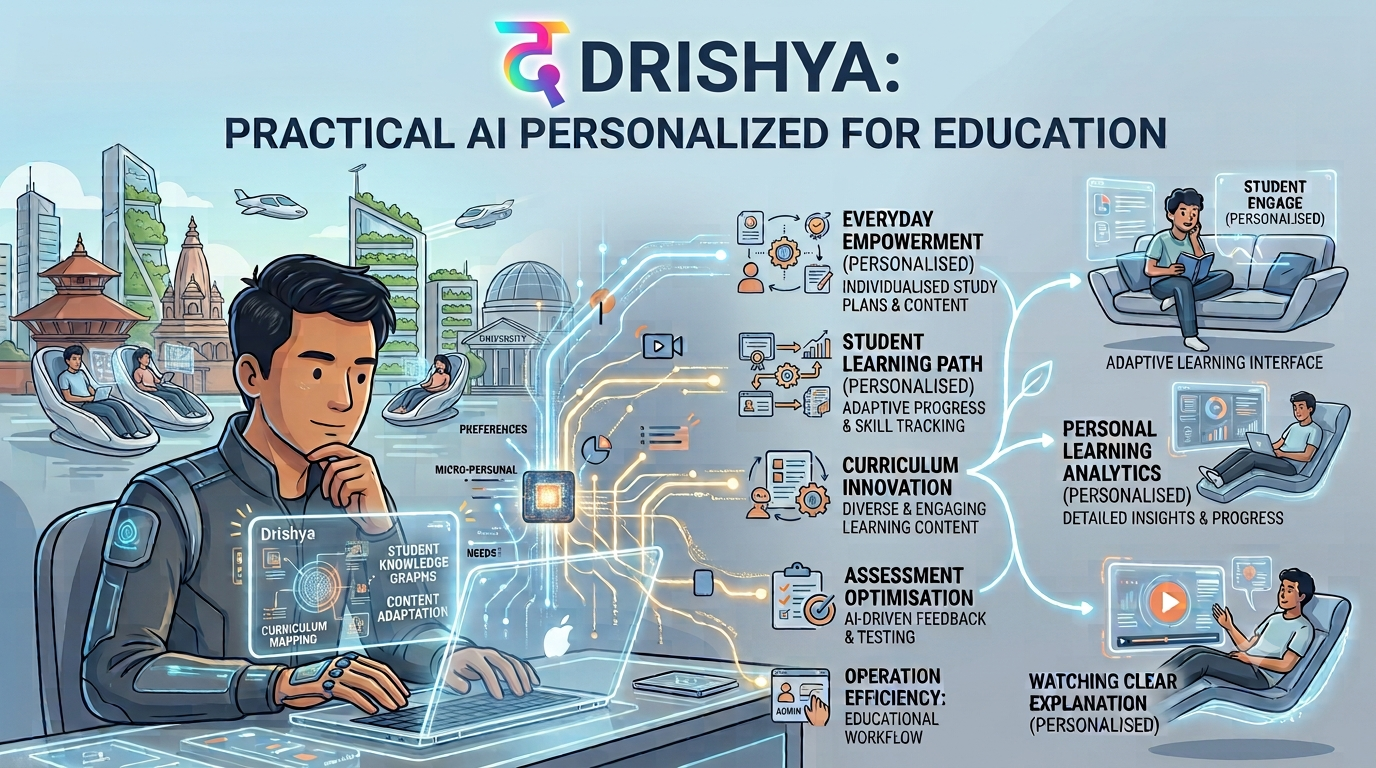
I keep getting asked what Drishya actually is, and I've noticed I give a different answer depending on who's asking. To a publisher I talk about curriculum blueprints and rendering pipelines. To a friend I usually just say "I'm trying to make AI actually useful instead of just impressive." That second answer is closer to the truth, so let me try to explain it properly here.
Where this started
When I moved from Nepal to the US to pursue technology, I ran into two hurdles right away: the crushing cost of education, and the isolation of figuring out a completely foreign system on my own. Earning my engineering degrees wasn't really an academic story for me — it was survival, resourcefulness, and a lot of financial discipline, stretched over years. I know exactly what it feels like to want to learn something badly and have the cost of learning it be the thing standing in the way. That's not an abstract problem to me. It's one I lived through.
That experience carried into my career, from working on automotive engineering at the Innovation Center Volkswagen to jumping into the fast pace of various startups. And somewhere in that path, I kept coming back to the same realization: the hurdle I fought through — the cost of learning something, the isolation of not having the right access or the right people around you — hasn't gone away for most people. It's just as real for someone today trying to learn a concept well as it was for me trying to afford a degree. Drishya is my attempt to actually do something about that, instead of just remembering it fondly as a hard chapter I got through.
What "practical AI" means to me
I've also noticed, over and over, how much of tech gets built to be unnecessarily complicated or exclusionary — intentionally or not. That's the culture Ghimire Labs exists to push back against, and Drishya is my sharpest attempt at it yet. What I actually wanted to build was something an ordinary person — not a studio, not a company with a production budget — could use to get something genuinely well-made done for them. I landed on animated video almost by accident, honestly. I was thinking about how much good explanation used to cost: an animator, a script writer, days of production, for one video that explains one idea well. That felt like exactly the kind of thing that shouldn't require a team, or money most people don't have, anymore.
Why accuracy matters more than the AI itself
The part I care about more than the AI itself is probably the least exciting part to talk about: making sure it's right. It's easy to generate something that looks impressive and is subtly wrong — a fact slightly off, a sequence out of order — and most people using the tool won't have the expertise to catch it. So under the hood, before anything gets animated, I turn the request into a structured spec first, something that can actually be checked, instead of just trusting the model to freehand it correctly every time. It's the same instinct that got me through engineering in the first place: don't trust something just because it looks finished.
What I want Drishya to become
If I'm honest about what I want Drishya to become, it's not a flashy thing. I want it to be the kind of clear, accessible tool I wish I'd had during my own uphill journey — something people just quietly use because it works, closer to how you'd use a spreadsheet than how you'd use whatever AI toy is trending this month. That's a much less exciting pitch than "revolutionizing education" or whatever, but it's the one I actually believe, and it's the bar I'm holding myself to.